Recommended Pedals
The essential Eq pedals to know about
EQ shapes frequency response—boosting or cutting specific ranges to change tone. It's fundamental tone-shaping that separates great-sounding rigs from mediocre ones. Yet EQ is often overlooked, treated as an "effect" rather than a necessary tool. The truth is every professional guitarist uses EQ, whether consciously or unconsciously. It's how you make your tone sit in a mix, how you compensate for amp characteristics, how you carve out presence from muddiness.
The Frequency Spectrum: What You're Actually Shaping
Audio ranges from 20 Hz (lowest bass) to 20 kHz (highest treble). Understanding these ranges is essential to understanding EQ.
The Bass Region (20-250 Hz)
Sub-bass (20-60 Hz): The lowest frequencies. Felt more than heard. Adds weight and power.
Bass (60-250 Hz): The fundamental of your guitar's low notes. Controls thickness and warmth.
Pro insight: Boosting below 80 Hz adds muddiness, not musicality. Most guitar tone lives above 100 Hz.
The Low-Mids (250-500 Hz)
The region where mud lives. Also where fundamental warmth and body exist.
Boost here: Creates thick, warm tone. Can become muddy if overdone.
Cut here: Creates clarity and separation. Can sound thin if excessive.
Pro use: Small boost (1-3dB) adds richness. Bigger cuts (6-12dB) remove muddiness from overdriven tones.
The Mids (500-2000 Hz)
The region where most guitar character lives. This is where your unique voice is.
Boost around 1kHz: Creates presence, cuts through mixes, obviously noticeable.
Boost around 2kHz: Adds aggression and edge.
Cut around 1kHz: Reduces nasal quality, creates darkness.
Pro insight: The famous "Tube Screamer midrange peak" is around 720Hz. That's this region.
The High-Mids (2-4 kHz)
The presence region. Where clarity and articulation live.
Boost here: Makes tone jump out of the mix. Increases pick definition and clarity.
Cut here: Reduces harshness, creates roundness.
Pro use: Massive boosts (6+dB) create obviously aggressive tone. Subtle boosts (1-2dB) add clarity without obviousness.
The Presence/Treble (4-8 kHz)
The brightness region. Controls sparkle, snap, and definition.
Boost here: Adds brightness, sizzle, pick attack definition.
Cut here: Reduces harshness and hiss, creates smoothness.
Pro use: A tiny presence peak (1-2dB) around 5kHz is common in professional tone.
The Brilliant/Air (8-16 kHz)
The shimmer and air region. Creates sense of space and openness.
Boost here: Adds shine and air. Can sound hyped or unnatural if overdone.
Cut here: Reduces brightness, creates darkness.
Pro insight: Most people can't hear above 14-15 kHz (it becomes inaudible with age). Boosting 8-12 kHz is often more effective than 12-16 kHz.
Hearing Frequency Changes: Training Your Ear
Small frequency adjustments are hard to hear. Here's how much change is perceptible:
1-2 dB boost/cut: Barely noticeable. Requires careful listening to hear.
3-4 dB boost/cut: Obviously noticeable. Most people hear this immediately.
6+ dB boost/cut: Dramatically noticeable. Changes the character significantly.
The Pro Insight: Most professional EQ work uses small adjustments (1-3dB). Large boosts/cuts sound unnatural. Start subtle and increase only if needed.
EQ Types: Architecture Matters
Graphic EQ
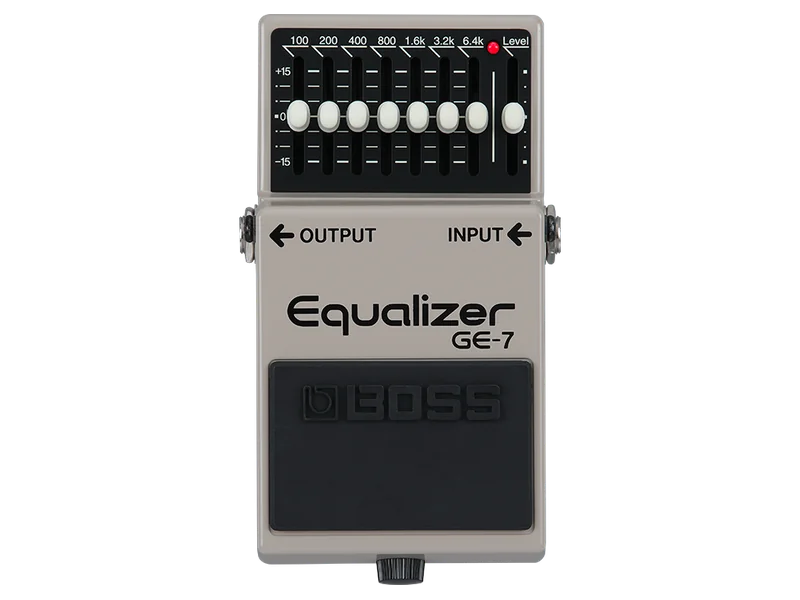
How it works: Fixed frequency bands (typically 7, 10, or 31 bands). You boost or cut each band independently using sliders.
Pros:
- Visual feedback (you see what you're doing)
- Simple to understand
- Straightforward interaction
- Great for beginners and professionals
Cons:
- Can't adjust center frequency or bandwidth
- Limited control (you're stuck with preset bands)
- Can create harsh transitions between bands
Best for: Quick tone shaping, amp compensation, visual feedback during setup.
Examples: Boss GE-7 (7-band standard), MXR 10-Band, dbx AFS2 (31-band professional).
Parametric EQ
How it works: Instead of fixed bands, you select center frequency, adjust bandwidth (Q), and control gain.
Pros:
- Maximum precision
- Can target exact problem frequencies
- Smooth transitions (adjustable bandwidth)
- Professional-grade control
Cons:
- More complex (three parameters per band)
- No visual feedback (harder to learn)
- Smaller number of bands (typically 3-4)
- Requires understanding of frequency concepts
Best for: Surgical tone shaping, fixing specific amp problems, professional applications.
Examples: Boss PQ-4 (4 parametric bands), Empirical Labs Distressor (3 bands with sidechain).
Shelf EQ (Treble/Bass Controls)
How it works: Like traditional tone controls. Boosts or cuts everything above/below a frequency.
Pros:
- Simple and intuitive
- Familiar (like amp tone controls)
- Great for overall tone shaping
Cons:
- Limited precision
- Affects wide range of frequencies
- Can't target specific problem frequencies
Best for: Overall tone enhancement, as a simple tone control addition.
Examples: Any amp's tone control, basic EQ pedals.
Notch Filter (Narrow Cut)
How it works: Surgically cuts a narrow band of frequencies. Used for problem elimination (hum, feedback, ringing).
Pros:
- Can eliminate specific problems
- Doesn't affect surrounding frequencies
- Surgical precision
Cons:
- Only cuts, can't boost
- Not useful for general tone shaping
- Requires knowing exact problem frequency
Best for: Eliminating ground loop hum, feedback peaks, ringing resonances.
Examples: Specialized notch filters, some parametric EQs can work as notch filters.
Frequency Chart: The Professional Reference
Bass and Warmth: 60-250 Hz
Muddiness: 250-500 Hz
Character and Voice: 500-2000 Hz
Presence and Clarity: 2-4 kHz
Brightness and Sizzle: 4-8 kHz
Air and Shimmer: 8-16 kHz
When You Hear...
- Muddy tone → Cut 200-400 Hz
- Nasal tone → Cut 1-2 kHz
- Dull tone → Boost 4-8 kHz
- Thin tone → Boost 100-200 Hz
- Harsh tone → Cut 2-5 kHz
- No presence → Boost 2-4 kHz
EQ in the Signal Chain: Placement Determines Function
EQ Before Drives (Shaping Input)
EQ affects how the drives respond to the signal.
Effect: A boosted 1kHz makes distortion respond more aggressively in that frequency. A cut 1kHz makes distortion less aggressive.
Use case: Shaping drive response for specific tone.
EQ After Drives (Shaping Output)
EQ shapes the final tone without affecting how drives respond.
Effect: A boosted 1kHz adds presence without changing drive character.
Use case: Compensating for amp characteristics, final tone polish.
EQ in Amp's Effects Loop (Correcting Amp)
EQ placed in amplifier's effects loop corrects the amp's natural response.
Effect: If amp is naturally dark, boost treble. If amp is harsh, cut presence.
Use case: Compensating for amp characteristics without stacking pedalboard.
The Professional Setup
Many pros use EQ twice:
- Early EQ: Subtle (1-2dB boosts) shaping drive input
- Late EQ: More aggressive, shaping final output
The Amp-EQ Relationship: Understanding Your Amp's Character
Dark/Warm Amp (Fender Deluxe, Vox AC30)
Naturally warm EQ with reduced treble presence.
EQ Strategy: Boost treble (4-8 kHz) to add brightness and cut through mixes.
Bright/Aggressive Amp (Marshall, Boss Katana)
Naturally bright with scooped mids.
EQ Strategy: Boost mids (1-2 kHz) to fill in character and reduce brittleness.
Flat/Transparent Amp (High-end solid-state, modeling amps)
Linear response requiring EQ shaping.
EQ Strategy: Shape according to desired tone, rather than compensating for amp.
Famous EQ Setups: Pro Reference Tones
Eddie Van Halen - Presence Peak
Van Halen's tone includes a presence peak around 2-4 kHz, adding aggression and cutting clarity to his high-gain distortion.
Lesson: A modest presence peak (2-3dB) adds aggression without harshness.
David Gilmour - Dark and Warm
Gilmour's EQ is remarkably flat, relying on his amp's natural warmth. Minimal EQ shaping.
Lesson: Sometimes the best EQ is no EQ. Let good tone be good.
Steve Vai - Scooped Mids
Vai's high-gain tone features slightly scooped mids (cut around 1kHz) with boosted bass and treble.
Lesson: A V-shaped EQ can work for lead tones, though muddy for rhythm.
2026 EQ Landscape
Graphic EQ Still the Standard
Boss GE-7 remains the industry standard. No real competition. It works and sounds great.
Parametric EQ Gaining Popularity
More players discovering parametric precision for surgical tone shaping.
Digital EQ Flexibility
Modeling platforms and DAWs offer unlimited EQ flexibility. 31-band graphic, parametric, dynamic EQ all available.
Integration into Pedalboards
More modern pedalboards (Boss ME-80, Fractal) include integrated EQ as standard feature.
Common EQ Mistakes
Mistake 1: Boosting Instead of Cutting
Boosting always adds digital noise floor. Cutting is cleaner. For problem frequencies, cutting is usually better than boosting.
Mistake 2: Using EQ as Master Volume
EQ adjusts tone, not volume. If you need volume, use a volume pedal. Using EQ to change volume is inefficient.
Mistake 3: Extreme Boosts/Cuts
Boosts/cuts beyond ±6dB sound unnatural. Most professional EQ uses ±1-4dB adjustments.
Mistake 4: Placing EQ in Wrong Spot
EQ after reverb affects reverb tone (usually bad). EQ should be before time effects, or in amp's loop.
Mistake 5: Not Understanding Your Amp
You can't EQ effectively without understanding your amp's natural character. Listen carefully to what your amp does before EQing.
Mistake 6: EQ as Bandaid
Using EQ to "fix" a bad amp or bad pickups. EQ enhances good tone; it can't save bad tone.
Troubleshooting With EQ
Problem: Tone Sounds Muddy
EQ solution: Cut around 250-400 Hz (low-mids)
Problem: Tone Lacks Presence
EQ solution: Boost around 2-4 kHz (presence region)
Problem: Tone Sounds Harsh
EQ solution: Cut around 2-5 kHz (high-mids)
Problem: Tone Sounds Thin
EQ solution: Boost around 100-200 Hz (bass/warmth)
Problem: Distortion Sounds Mushy
EQ solution: Boost around 4-8 kHz (brightness/clarity)
Problem: Clean Tone Lacks Sparkle
EQ solution: Boost around 5-8 kHz (presence/air)
Problem: Ground Loop Hum
EQ solution: Notch filter around 50/60 Hz (power-line frequency)
The EQ Philosophy
EQ is the most underrated tone-shaping tool. Every professional guitarist uses it, yet many amateurs ignore it. The difference between muddy amateur tone and clear professional tone is often just good EQ.
The best EQ is subtle. Small adjustments (1-3dB) sound natural. Large boosts/cuts sound processed. Learn to listen for problems and use EQ surgically to fix them.
EQ doesn't add character—it reveals it. Good tone needs good EQ to shine. Master EQ and you've unlocked the secret to making mediocre gear sound great.
Live Eq Price Index
UK & European retailers • Updated daily
| Pedal | Style | Country | Price |
|---|---|---|---|
| Boss GE-7 Equalizer | Graphic | Japan | €107 |
| Empress Paraeq | Parametric | USA | €277 |